

Coliving spaces thrive on connection, but without a community manager, they risk becoming just another rental property. Here's why these professionals are essential:
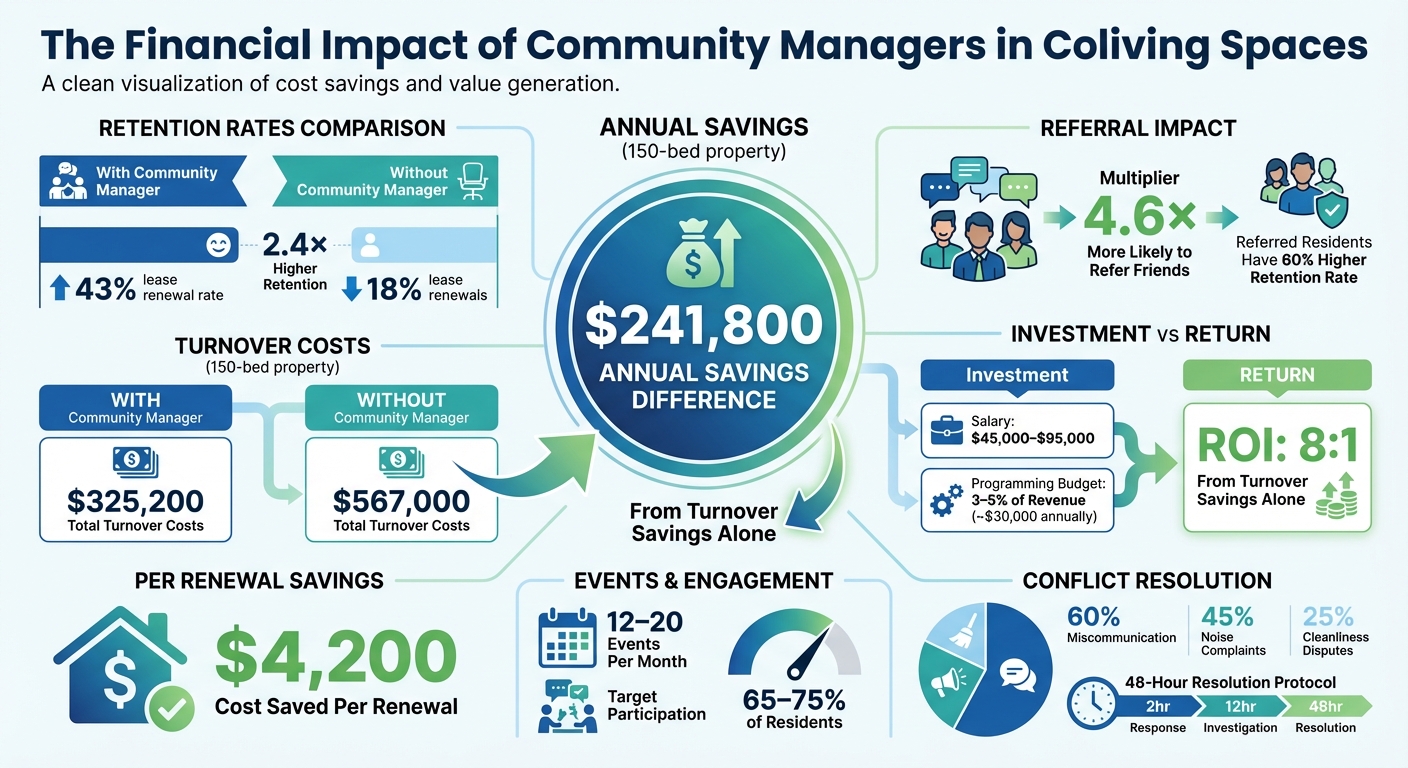
- Higher Retention Rates: Properties with structured community programs see a 43% lease renewal rate, compared to 18% without them. This saves operators up to $241,800 annually.
- Conflict Resolution: Community managers resolve issues like noise complaints and cleanliness disputes using structured protocols, preventing resident turnover.
- Events and Engagement: They organize 12–20 events per month, boosting participation and creating bonds among residents.
- Financial Impact: Every renewal saves $4,200, and engaged residents are 4.6 times more likely to refer friends, reducing marketing costs.
Community managers aren’t just facilitators - they’re the backbone of a thriving coliving experience, ensuring residents feel connected and operators see financial success.
Financial Impact of Community Managers in Coliving Spaces
The Community Problem in Coliving Spaces
Problems Without a Community Manager
When coliving spaces operate without a community manager, things can go downhill fast. Residents are often left with just a key and no sense of connection or shared purpose, leading to a threefold increase in churn within the first 90 days.
Communication breakdowns are common, and small problems - like noise complaints or messy kitchens - can spiral out of control. In fact, 60% of conflicts stem from miscommunication or unmet expectations.
Events, when they happen, are irregular and poorly planned. Instead of fostering a sense of belonging, the space starts feeling like a temporary hotel rather than a true home.
These operational gaps don’t just disrupt daily life - they also come with serious financial consequences.
Effects on Resident Experience and Retention
The lack of proper community management hits residents hard. Daily frustrations pile up, leading to more people leaving and higher costs for the property.
The financial impact is undeniable. Poor community management creates a retention gap that directly affects profitability. For a 150-bed property, the numbers tell the story: without strong community support, 123 residents leave annually, compared to just 86 with proper management. This results in $567,000 in turnover costs, compared to $325,200 with better retention - a staggering $241,800 difference each year.
And it’s not just about the money. The human cost is real too. A single unresolved conflict can drive away 3 to 5 good residents, as they’d rather move out than deal with ongoing drama. This ripple effect can severely damage the sense of community that coliving spaces aim to create.
What Community Managers Do
Community managers play a key role in the success of coliving spaces. They handle everything from onboarding new residents to organizing events and managing conflicts. Their efforts shape whether residents feel a genuine sense of home or see their stay as just a rental experience.
Building Connection and Belonging
To ensure smooth integration, community managers reach out to new residents within 24 hours. They use tools like one-on-one meetings and a "buddy system", where seasoned residents help newcomers adjust to their new environment.
"We hire former teachers more than any other background. They know how to command a room, manage group dynamics, handle conflicts gracefully, and demonstrate genuine care for resident wellbeing." - Head of Community, Common Living
A big part of their job is creating a space where residents feel safe to express themselves and connect with others. Recognizing residents who contribute positively - like helping neighbors or enhancing shared spaces - strengthens this sense of community. This approach has measurable benefits: engaged residents are 4.6 times more likely to refer friends compared to those who feel disconnected. By fostering these connections early on, community managers also set the stage for smoother conflict resolution down the line.
Resolving Conflicts Between Residents
When disagreements arise, community managers step in as impartial mediators, following a structured 48-hour conflict resolution protocol. This includes responding to issues within 2 hours, investigating within 12, and resolving them within 48.
The process starts with gathering written accounts from everyone involved before offering solutions. For example, noise complaints, which make up 45% of all conflicts, are addressed by enforcing quiet hours (typically 10:00 PM to 8:00 AM). For cleanliness disputes (25% of conflicts), managers use reminders like "clean as you go" signs and arrange professional cleanings 2–3 times per week. Follow-ups on Day 7 and Day 14 ensure that agreements are being upheld.
"Keeping one problem resident costs you 3-5 good residents who will leave rather than deal with ongoing conflict." - Maria Gonzalez, VP of Community Operations, Common Living
Planning Events and Activities
Community managers also breathe life into coliving spaces by organizing engaging events. They typically plan 12–20 events per month, divided into categories: 40% social, 25% professional development, 20% wellness, and 15% cultural.
The aim is to have 65–75% of residents participate, ensuring that at least two-thirds of the community attends at least one event each month. This well-thought-out programming boosts engagement, strengthens bonds, and transforms coliving spaces into vibrant, connected communities.
Benefits for Residents and Operators
Community managers play a crucial role in keeping residents happy and ensuring operators see strong financial results. They’re often the difference between a thriving community and one plagued by high turnover.
Better Resident Satisfaction and Retention
When residents feel connected, they stick around longer. Properties with active community management boast 43% lease renewal rates, compared to just 18% for those without. That’s the difference between a vibrant, stable community and a constant shuffle of new faces.
Residents value the friendships they build. Organized events and casual daily interactions create bonds that make leaving feel like giving up a support system. For instance, a U.S.-based coliving space found that 68% of residents noticed an improvement in their social lives thanks to scheduled events. These emotional ties lead to longer stays and fewer empty units.
This sense of connection doesn’t just keep current residents happy - it also encourages organic growth within the community.
Stronger Community and Growth Metrics
Community managers help turn residents into enthusiastic advocates. Engaged residents are 4.6 times more likely to refer friends than those who feel isolated. Even better, referred residents stick around longer, with a 60% higher retention rate than those brought in through paid ads. This creates a feedback loop where satisfied residents bring in others who are just as likely to stay.
A key metric for measuring this success is the "Social Connection Index", which tracks the average number of friendships per resident. Properties with strong community management typically see residents form 4–6 friendships. When that number dips below 3, it’s a red flag for potential churn. Community managers actively monitor and boost these connections through thoughtful programming and well-designed spaces.
Return on Investment for Operators
Better retention and stronger community ties translate into significant financial benefits for operators. For a 150-bed property, increasing the renewal rate from 18% to 43% can save around $241,800 annually in turnover, vacancy, and marketing costs. Each renewal saves about $4,200 - money that would otherwise go toward replacing departing residents.
Community manager salaries typically range from $45,000–$95,000, depending on property size, with an additional 3–5% of total revenue allocated for programming. For a 150-bed property, this adds up to roughly $30,000 annually in community investments. The payoff? An estimated 8:1 ROI from turnover savings alone, not to mention the added value of referrals and a stronger reputation.
"Community isn't a cost center - it's your competitive advantage, your retention engine, and your growth strategy all in one." - Maria Gonzalez, VP of Community Operations, Common Living
How Coliving.com Supports Community Managers
Running a successful coliving space relies heavily on skilled managers and reliable systems. Coliving.com bridges this gap by connecting operators with seasoned professionals and offering digital tools tailored for management. These resources strengthen the role of community managers, helping every coliving space thrive. Here's how Coliving.com simplifies hiring and day-to-day operations.
Finding the Right Community Manager
Coliving.com taps into its global network of 750 hosts and professionals to help operators find community managers who truly understand the unique challenges of coliving. The platform prioritizes candidates with backgrounds in fields like hospitality, education, or student affairs - industries where skills like managing group dynamics and resolving conflicts are second nature.
"Community managers need even more soft people skills and diplomacy than [property managers], because you often live inside the community that you work." - Nicole Reese, Community Builder
With median salaries reaching $103,215 in Miami and entry-level averages at $87,699, Coliving.com ensures operators can connect with candidates who have a proven history of fostering vibrant communities. Once the right person is hired, the focus shifts to equipping them with efficient systems.
Management Tools and Features
Coliving.com provides tools like online rental agreements and integrated management systems that automate routine tasks. This allows managers to dedicate more time to building relationships with residents.
The platform's fully online process also simplifies tracking critical metrics, such as event attendance and lease renewals - key indicators of a well-managed community. With 1,900 coliving spaces across 380 cities already leveraging these tools, operators gain access to a system that’s designed to grow alongside their needs.
How to Make Community Management Work
Hiring a community manager is just the starting point. To truly succeed, you need clear systems, active resident involvement, and ongoing development. These three elements are what make or break effective community management.
Setting Clear Goals and Expectations
From day one, community managers need well-defined responsibilities. Their core tasks should include onboarding new residents within 24 hours, organizing 12–20 events every month, managing online communication platforms, and resolving conflicts using established protocols. The ultimate aim? Help residents integrate into the community, create opportunities for connection, and encourage behaviors that strengthen bonds.
To measure success, focus on metrics like event participation rates, resident referrals, and conflict resolution times. For example, aim for a Net Promoter Score (NPS) between 50 and 70 and a referral rate of 15–25%. Conflict resolution should happen within 24 hours or less. In 2024, a coliving property in Austin, TX, with 180 residents achieved a 68% event participation rate and a 47% lease renewal rate by sticking to a structured event schedule with a monthly budget of $1,595.
It’s also important to set boundaries. Community managers shouldn’t be expected to handle sales, marketing, building maintenance, or complex mediations that exclude resident input. Their role should focus on facilitation, encouraging residents to take the lead on events and house rules rather than relying on top-down management.
With these frameworks in place, let’s explore how to make these strategies actionable.
Using Resident Feedback
Once goals are established, the next step is to actively collect and act on resident feedback. Use quarterly NPS surveys to gauge overall satisfaction and track a Social Connection Index to measure how many meaningful friendships residents form. Strong communities typically see 4 to 6 genuine friendships per resident, while scores below 3 signal a higher risk of turnover.
Consolidate feedback into a monthly dashboard to turn insights into action. This helps justify community budgets by connecting satisfaction rates to retention outcomes. Revise house rules regularly based on resident input to ensure they stay relevant as the community evolves. When conflicts arise, acknowledge feedback within 2 hours and share a resolution plan within 24 hours to show responsiveness.
Training and Development
Community management thrives on human connection, which means continuous skill development is essential. Focus on soft skills like conflict resolution and empathy. Interestingly, Common Living found in 2024 that their most successful community managers were former educators 60% of the time, thanks to their ability to manage group dynamics and handle conflicts with grace.
Invest in training programs that teach frameworks like Radical Candor or "Beginning Anew" for collaborative decision-making. While hard skills like event planning, first aid, and emergency response are important, emotional intelligence is what truly sets great community managers apart. To avoid burnout, enforce clear "off-duty" hours so managers don’t feel like they’re always on call.
"The biggest gift that community managers can bring is their own creativity and individuality to build up a space. And they should be empowered to do so." - Gui Perdrix, Community & Experience Consultant, Art of Co
When hiring, consider recruiting former residents who already understand your community’s culture. Pair new managers with experienced team members through a buddy system to ensure a smoother transition and knowledge-sharing process.
Conclusion
Community managers play a key role in the success of any coliving space. Without their guidance, residents may struggle to form connections, disputes can go unresolved, and turnover rates often spike. On the other hand, a skilled community manager fosters engagement, encourages longer stays, and creates an environment where residents feel at home. This directly addresses the challenges of isolation and frequent turnover.
Data backs this up: strong community programs can lead to a 43% renewal rate and generate 4.6× more referrals, saving around $4,200 per renewal.
The key to success lies in setting clear goals, gathering ongoing feedback, and offering the right support. Hiring managers with soft skills like empathy and conflict resolution - not just event planning - helps create spaces where people truly want to stay.
Platforms like Coliving.com make this process easier by handling the administrative tasks - digital rental agreements, all-inclusive billing, and lead qualification - so community managers can focus on what truly matters: building meaningful connections. With access to a pool of vetted residents from 380 cities and over 70 countries, you start with individuals who already share your community's values. Together, these tools and strategies help every coliving space thrive.
FAQs
How do community managers help increase lease renewals in coliving spaces?
Community managers play a crucial role in encouraging lease renewals in coliving spaces by creating an environment where residents feel connected and valued. When people experience a sense of belonging and support, they’re much more likely to stay, which helps reduce turnover and the costs that come with it.
They make this happen by hosting engaging events, fostering interactions in shared spaces, and keeping communication open and approachable. By quickly resolving conflicts and promoting an inclusive atmosphere, community managers boost resident satisfaction and loyalty. The result? A vibrant, stable community that people are eager to call home for the long haul.
What are the key skills a community manager needs in a coliving space?
A community manager in a coliving space needs a blend of people skills, organizational abilities, and clear communication. They should be approachable and friendly, with a knack for bringing people together to create a welcoming, connected atmosphere. Strong communication plays a key role in organizing events, facilitating group activities, and keeping residents engaged - whether through digital platforms or face-to-face interactions.
They also need to be flexible and calm under pressure, ready to handle conflicts or unexpected situations while maintaining a positive vibe within the community. Hosting activities like potlucks, workshops, or game nights and thoughtfully designing shared spaces are essential for encouraging meaningful connections. A great community manager balances warmth, emotional awareness, and thoughtful planning to create a space where everyone feels at home.
How do community managers help resolve conflicts between residents?
Community managers are essential in resolving conflicts, creating an atmosphere of understanding and cooperation. They focus on encouraging open communication and tackling potential problems before they escalate. Common sources of tension, like noise complaints, cleanliness concerns, or disagreements over shared spaces, are often identified early, with clear guidelines set to prevent confusion.
When conflicts do arise, community managers step in to mediate. They facilitate respectful conversations, ensuring everyone has the chance to express their concerns and work toward mutually acceptable solutions. By nurturing a sense of empathy, respect, and shared accountability, they contribute to a peaceful and supportive community. For more challenging disputes, they may rely on structured conflict resolution methods to address issues effectively and constructively.