

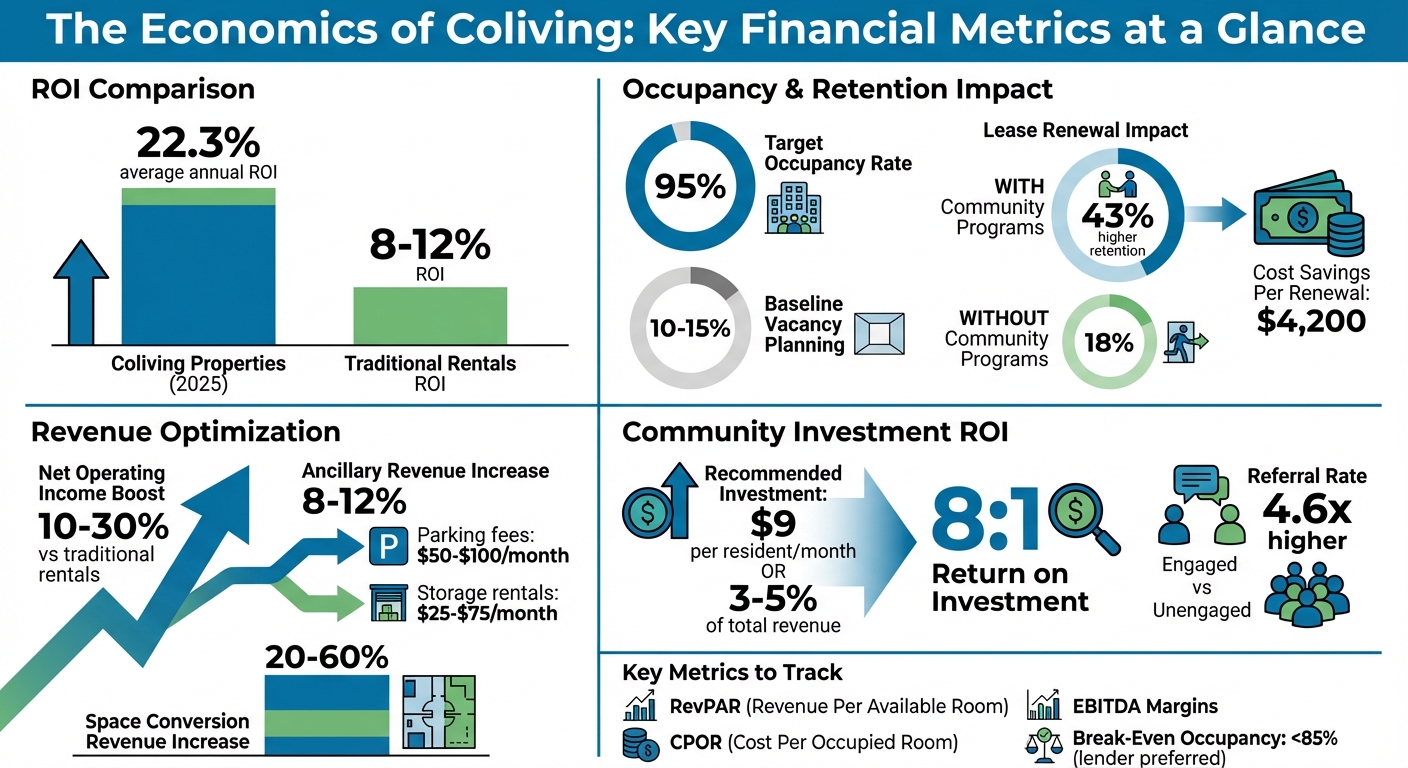
Coliving is reshaping housing by combining shared spaces with private rooms, offering a balance between affordability and community. Operators can achieve higher returns - up to 22.3% ROI - compared to 8–12% for conventional rentals. However, profitability depends on managing costs, optimizing revenue, and maintaining tenant satisfaction.
Key insights:
- Metrics to track: Revenue Per Available Room (RevPAR), Cost Per Occupied Room (CPOR), and EBITDA margins.
- Revenue strategies: Tiered pricing, dynamic rates, and ancillary income (e.g., parking fees, storage rentals).
- Cost-saving measures: Energy-efficient upgrades, smart utility management, and sustainable building materials.
- Tenant retention: Community programs boost lease renewals (43% vs. 18%) and cut turnover costs by $4,200 per resident.
- Growth tips: Expand carefully, prioritize community, and use technology for efficient management.
Coliving thrives when operators focus on financial performance and creating a sense of belonging. This dual approach ensures long-term success and scalability.
Coliving Financial Metrics: ROI, Occupancy Rates, and Cost Savings Comparison
Core Financial Metrics for Coliving Operations
Tracking the right metrics is what sets thriving coliving operations apart from those that struggle. Unlike traditional rentals, which mostly focus on occupancy and rent collection, coliving spaces require a more tailored approach due to their shared areas, added services, and community-focused programming.
Three key metrics are at the heart of effective financial management for coliving: Revenue Per Available Room (RevPAR), Cost Per Occupied Room (CPOR), and EBITDA margins. These metrics help operators understand revenue generation, manage costs, and evaluate overall profitability. Let’s break down how each one works.
Revenue Per Available Room (RevPAR) and Occupancy Rates
RevPAR measures how much revenue each room generates, whether it’s occupied or not. You can calculate it by multiplying the average daily rate by the occupancy percentage or by dividing total room revenue by the number of available rooms. This metric gives insight into both pricing strategy and space utilization.
For coliving spaces, maintaining a 95% occupancy rate is a strong target, though operators should plan for a baseline vacancy of 10–15% to account for tenant turnover. The potential returns are impressive - projections for 2025 suggest an average annual ROI of 22.3% for coliving properties, compared to just 8–12% for traditional rentals.
Community programming plays a big role in achieving high occupancy and lowering marketing costs. Hiring a Community Manager (CM) can make a noticeable difference. For example, GotColiving notes, “A $55K CM only needs to improve retention by 10 percentage points (from 35% to 45%) to cover their salary.”
Cost Per Occupied Room (CPOR) and Break-Even Analysis
CPOR tracks the average operating expenses per occupied room, including costs like utilities, maintenance, cleaning, community events, and management fees. It’s calculated by dividing total operating expenses by the number of occupied room-nights over a specific period. Keeping an eye on CPOR helps operators spot rising costs early, before they eat into profits.
Another critical figure is the break-even occupancy (BEO) - the minimum occupancy rate needed to cover all operating expenses and debt obligations. To calculate it, add up operating expenses and annual debt service, then divide by the gross potential income (assuming full occupancy). Lenders usually prefer a break-even ratio of 85% or less, as higher ratios indicate thinner safety margins and greater risk.
Operators should review their BEO quarterly and stress-test their financial models by simulating scenarios like a 5–15% rent drop or a 3–8% expense hike. Many also boost revenue with ancillary streams, such as:
- Parking fees ($50–$100 per month)
- Storage rentals ($25–$75 per month)
- Guest stay charges
These extras can increase revenue by 8–12%, reducing the occupancy rate needed to break even.
EBITDA Margins for Coliving Spaces
While CPOR highlights cost structures, EBITDA margins provide a deeper look into operating profitability, making it a crucial metric for understanding the financial health of coliving operations.
EBITDA (Earnings Before Interest, Taxes, Depreciation, and Amortization) focuses on core performance by excluding financing and tax factors. This is especially relevant for coliving, where bundled services and community-driven models differentiate it from standard rentals.
Coliving properties often outperform traditional rentals in profitability, with the potential to boost Net Operating Income by 10–30% due to their denser layouts and mixed-use features. However, achieving strong EBITDA margins requires careful cost control. For instance, successful operators typically invest about $9 per resident per month in community programming - a sweet spot for driving engagement without hurting profits.
When calculating EBITDA, it’s essential to include capital reserves alongside operating expenses. Leaving out reserves can create an overly optimistic picture of profitability. Tracking EBITDA margins monthly helps operators spot trends and adapt quickly, ensuring efficient operations and sustainable growth.
How to Maximize Revenue in Coliving
Boosting revenue in coliving isn’t just about raising rents. The most successful operators tap into multiple income streams and fine-tune pricing to align with market demand and tenant preferences. This approach not only improves profitability but also enhances the resident experience, making premium pricing feel justified. Let’s dive into strategies that help achieve this balance.
Dynamic Pricing and Premium Services
Dynamic pricing adjusts rates based on demand and local events. For example, prices can rise during festivals or peak moving seasons and drop during slower periods. Tiered pricing is another effective tactic, offering different room types at various price points. A basic tier ($300–$600 per month) might include shared rooms, while an exclusive tier ($1,800–$3,000 per month) offers private suites with premium amenities. Presenting the premium option first can make mid-tier options seem more appealing and affordable - a psychological trick known as anchoring.
Strategic discounts can also drive revenue. Some coliving spaces offer reduced rates to "skilled guests" who contribute services like photography or web design. Others use collaborative pricing, where a portion of the rent is allocated to a shared fund for communal needs. To ensure profitability, calculate break-even points at both full and partial occupancy, factoring in typical vacancy rates and management fees. Referral and loyalty discounts can further reduce customer acquisition costs while fostering a sense of community.
Additional Income Sources
Maximizing space usage is one of the easiest ways to boost revenue. Converting underutilized areas - like living rooms, garages, or basements - into additional bedrooms can increase revenue by 20% to 60% compared to traditional single-family leases.
A great example comes from Emanuel "E" Premate, who, in October 2025, converted a three-bedroom short-term rental near Jacksonville, FL, into a five-unit coliving space using the PadSplit platform. This change increased monthly revenue to $5,000–$5,750. Similar conversions have helped property owners double their Net Operating Income by transitioning traditional homes into coliving spaces.
Beyond space optimization, ancillary services can add another 8–12% to total revenue. Parking fees ($50–$100 per month), storage rentals ($25–$75 per month), and guest stay charges are simple ways to increase income. Some operators also charge service and cleaning fees, which can amount to around $225 per month.
Utility management is another area ripe for efficiency. Digital platforms can centralize contracts for water, electricity, and internet, saving both time and money. For example, Badi, a coliving operator in Spain, used the Polaroo platform to save over 1,400 administrative hours and $13,200 in utility-related costs.
By combining space optimization, ancillary services, and smart utility management, operators can unlock significant revenue potential.
Pricing Strategies for Different Tenant Groups
Tailoring pricing to specific tenant groups can further enhance profitability. Each group has distinct needs and price sensitivities, which should inform how you structure your offerings.
- Remote workers and digital nomads: This group values flexible leases, strong Wi-Fi, and community-focused spaces. They’re often willing to pay $1,200–$1,800 per month for well-designed spaces with coworking zones and networking events.
- Students and recent graduates: Affordability is key for this group, but they still want social connections. Basic to medium-tier options ($300–$1,200 per month), especially those bundled with utilities and internet, work well here. Coliving often offers a 30% discount compared to traditional housing, making it an attractive option for budget-conscious renters.
- Long-term residents: Stability and predictability are priorities for this group. Subscription-based pricing models can meet these needs while offering operators steady revenue. Modest discounts (5–10%) for six-month or annual commitments can also reduce turnover costs.
To set pricing floors, understand your break-even occupancy rate and research comparable spaces in the market. While top urban coliving spaces often achieve occupancy rates of 95% or higher, it’s wise to plan for a 10–15% vacancy to account for fluctuations.
"Professional coliving organizations fail when the cost of managing that complexity exceeds the rental premium realized by the density."
- Daniel Kronovet, author of Community Systems
Testing pricing strategies with small groups before a full rollout can help identify what resonates with different tenant segments. This ensures you’re pairing the right price with the right resident while keeping profitability intact. These revenue-focused strategies work hand-in-hand with cost-saving measures to keep coliving both profitable and appealing.
How Sustainability Reduces Costs and Increases Profit
Sustainability isn’t just about helping the environment - it can also boost your bottom line. Eco-friendly practices lower operating costs, attract tenants who value green living, and increase property value. The trick lies in choosing investments that pay off quickly and involving residents in the process.
Energy Efficiency and Lower Utility Costs
Advancements in smart technology and renewable energy are turning utilities from a major expense into a competitive edge. For example, intelligent thermostats use machine learning to adjust heating and cooling based on real-time occupancy, cutting HVAC use without sacrificing comfort. Similarly, LED lighting equipped with motion and daylight sensors ensures lights only operate when necessary, automatically adjusting brightness to match ambient light levels.
Solar panels are now a common feature in premium coliving spaces, helping reduce reliance on traditional energy grids and providing predictable energy costs. ENERGY STAR appliances in shared kitchens and laundry areas further reduce energy waste in high-usage spaces. IoT monitoring systems add another layer of efficiency by tracking energy consumption in real time, identifying unusual spikes, and enabling predictive maintenance to address issues before they escalate.
"Green homes require a higher upfront investment but result in significant long-term savings - especially on maintenance and utility bills." - Julie Boudrias, Residential Advisor, CAA-Quebec
A great example of this is Enso Co-living in Spain. By using Polaroo supply management software to centralize utility tracking for over 140 properties and 2,600 invoices, they saved more than €20,000 ($21,600).
Even something as simple as building orientation can make a difference. South-facing windows can capture passive solar heating, cutting heating costs by 15% to 20%, while extended roof overhangs can block up to 90% of summer sunlight, reducing cooling expenses. Before diving into expensive upgrades, sealing the building envelope to eliminate air leaks is a cost-effective first step, as these leaks are a major source of energy waste.
Beyond energy savings, choosing sustainable building materials can further reduce costs while improving efficiency.
Eco-Friendly Building Materials and Design
Although green building materials often come with higher upfront costs, they deliver savings over time. For instance, mass timber structures have about 60% less embodied carbon compared to concrete buildings. Using locally sourced materials - like timber in forested areas or rammed earth in grasslands - not only cuts transportation costs but also supports local economies.
Passive design strategies also help maximize natural resources. Orienting buildings north-south and adding large windows on south-facing walls reduces the need for artificial lighting and heating. High-performance insulation made from materials like sheep’s wool, straw bales, or recycled cellulose provides excellent thermal resistance at a lower cost compared to many synthetic options.
Take the University of Calgary, for example. In December 2023, they began constructing the Veterinary Learning Commons with a goal of LEED Gold certification. By working with suppliers to use low-carbon concrete, they significantly reduced the embodied carbon in their main structural material - a growing trend in both residential and commercial projects.
Water-saving fixtures are another way to see immediate returns. Upgrading to dual-flush toilets (1.28 gallons per flush) and aerator-equipped faucets (1.5 gallons per minute) can start lowering water bills right away. Modular and prefabricated systems can also speed up construction timelines and minimize waste, making projects more cost-effective from the outset.
But sustainability isn’t just about the building itself; engaging tenants in green initiatives can amplify savings and strengthen the community.
Tenant-Driven Sustainability Programs
When residents take an active role in sustainability efforts, they tend to stay longer and require less management. Community-led initiatives like shared gardens, composting stations, and recycling programs foster a sense of ownership and belonging. This sense of community often leads to higher lease renewal rates and lower turnover costs.
Bulk-buying programs for household essentials - such as detergents and cleaning supplies - can reduce packaging waste while saving residents money.
"The social, environmental and economic impact – also known as social value – of coliving projects can be significant if these aspects are at the core of what they do." - Matthew Lesniak, Co-Founder, Conscious Coliving
Sustainability credentials also attract institutional investors. Certifications like BREEAM or LEED and strong ESG metrics can increase property values and make financing more accessible. Many investors now favor retrofitting older buildings over new construction to reduce embodied carbon, opening up opportunities for operators willing to upgrade existing properties. By weaving sustainability into daily operations and encouraging tenant participation, coliving spaces can cut costs while building thriving, profitable communities.
Growth and Expansion Strategies
Scaling a coliving business means finding the sweet spot between growing quickly and keeping the sense of community and quality that made your first property successful. Smart operators take a careful, data-driven approach to ensure consistency across all locations.
Expanding to Multiple Locations
Picking the right markets is crucial for successful expansion. Start by assessing the basics, like reliable high-speed internet and access to healthcare facilities - both are essential for keeping residents happy. Walkability is another key factor; if residents can easily run daily errands without a car, satisfaction scores tend to rise.
You'll also need to decide whether to buy or rent properties. Buying gives you long-term stability, property appreciation, and full control over renovations, but it demands significant upfront capital and ties up cash flow. Renting, on the other hand, is more flexible and lets you test new markets with lower initial costs, though it comes with risks like rent hikes or lease terminations.
Take Spain as an example: the flex living market there is expected to nearly double to 20,000 beds by 2025. In 2022, the coliving sector in the country generated 433 million euros in turnover, with occupancy rates averaging over 95%. When exploring new locations, keep an eye on local regulations. For instance, in the UK, coliving often falls under a "sui generis" planning class, which doesn't fit traditional residential categories. This can lead to varying attitudes from local authorities.
By carefully choosing locations and staying true to a community-focused approach, you can maintain the essence of what makes coliving work - even as you grow. Once you've mapped out your physical expansion, technology becomes a key tool for keeping operations running smoothly.
Using Technology to Improve Operations
When managing multiple properties, technology shifts from being a convenience to an absolute necessity. In fact, the global property management software market hit $5.51 billion in 2023 and is expected to grow by 8.9% annually through 2030. This shows just how vital these tools have become.
For smaller operators, modular systems are a smart choice. These let you pay only for the features you need, allowing your tech to scale alongside your business. Tools like digital onboarding with automated welcome packets and electronic lease signing make move-ins seamless while setting clear expectations for residents. Real-time maintenance ticketing, complete with photo uploads, replaces chaotic phone calls with streamlined workflows.
Take Enso Co-living, a Spanish company managing a portfolio worth €120 million ($129.6 million). They use supply management software to simplify operations across multiple properties, cutting down on administrative work and costs.
Looking ahead, autonomous AI agents are expected to take on more complex property management tasks by 2026. This "Service With a Software" (SWAS) model combines software with managed services, optimizing supplies and utilities while integrating operations into a single system.
Market Trends and Growth Opportunities
As operational efficiency improves, market trends are creating new opportunities for scalable, tech-focused coliving solutions. What started as an experimental model has grown into a recognized asset class that's attracting serious institutional investment. In the first half of 2023, coliving accounted for 31% of all investments in the "flex living" residential sector, proving its financial appeal.
The demographic shift in coliving is also worth noting. While it initially catered to students, the focus has shifted to young professionals and digital nomads who value flexibility and strong infrastructure. These urban nomads often prefer short-term leases and subscription models that let them move between locations with ease.
Community programming is another big factor for success. Properties with active community events see a 43% lease renewal rate, compared to just 18% for those without. This translates to savings of around $4,200 per renewal by cutting costs associated with marketing, vacancies, and turnovers. Successful operators typically allocate 3% to 5% of their total revenue to community programs, which can deliver an impressive 8:1 return on investment.
For properties with more than 100 beds, hiring a full-time Community Manager is a smart move. Look for someone with a background in hospitality or education rather than traditional property management. Engaged residents are far more likely to refer friends - 4.6 times more often, in fact - dramatically lowering customer acquisition costs.
Sustainability is another area where coliving shines. ESG-conscious investors are increasingly drawn to retrofit-first projects that lower embodied carbon and improve operational efficiency. Upgrading existing properties not only makes financial sense but also aligns with the growing demand for eco-friendly solutions, reinforcing coliving as a model that balances growth with responsibility.
Key Takeaways
In coliving, profitability hinges on fostering a sense of community - not merely filling beds. Properties that prioritize strong community programming see a 43% lease renewal rate, compared to just 18% for those that don't. This focus can save operators around $4,200 per renewal by reducing expenses like marketing, vacancy periods, and turnover. It's the difference between thriving and just getting by.
"Community isn't a 'nice-to-have' in coliving - it's the entire business model." - Maria Gonzalez, VP of Community Operations, Common Living
Engaged residents are 4.6 times more likely to refer friends than unengaged ones, which slashes customer acquisition costs significantly. For properties with 100+ beds, having a full-time Community Manager - ideally with experience in hospitality or education - is critical. Investing in community efforts can deliver an impressive 8:1 return on investment.
Metrics like event participation rates (65–75%) and the formation of 4–6 friendships per resident directly impact retention, referrals, and overall performance. By treating community as a core advantage, operators can turn coliving from a basic rental model into a scalable, long-term success story. Engaging residents isn't just good for retention - it’s the foundation for sustainable growth.
FAQs
What break-even occupancy should I target?
A typical break-even occupancy rate for coliving spaces hovers around 73%. This figure is crucial because it allows operators to cover their operational costs while still turning a profit. Hitting this percentage strikes a balance between expenses and revenue, making it an important target for those managing coliving spaces to ensure financial health.
Which upgrades reduce utilities the fastest?
Smart energy systems are one of the quickest ways to cut down on utility costs. These systems use IoT sensors and centralized controls to automate heating, cooling, and lighting, ensuring energy isn't wasted. By optimizing energy use, they can reduce utility bills by as much as 20%.
When should I hire a Community Manager?
When your coliving space expands to a point where managing it becomes too demanding, it’s time to bring in a Community Manager. Generally, this happens when you have around 20-35 beds, which may justify a part-time manager. For spaces with 35+ beds, a full-time role is often necessary.
A Community Manager plays a key role in keeping residents happy and engaged. By improving retention and reducing turnover, they help cut costs associated with finding new tenants. More importantly, they create a better living experience, making their contribution well worth the investment.